


Good employee survey questions ask about a specific work experience, give people a balanced way to answer, and point to something your team can change. Cover overall satisfaction, workload, manager support, communication, development, and speaking up. Use ratings to find patterns and optional comments to understand them.
The 30 questions below are an original question bank, not a recommendation to send a 30-question survey. Choose the ones connected to a decision you actually own. For a first check-in, the six-question starter below is enough to begin a useful conversation.
A six-question employee survey you can start with
For a general team check-in, use questions 1, 6, 11, 16, 21, and 30 from the bank. They cover overall experience, capacity, manager support, communication, growth, and the employee's own priority. Keep the final comment optional.
Add an introduction that names the purpose, closing date, who can see individual responses, and when employees will hear what happens next. Do not describe a survey as anonymous if names, email addresses, hidden identifiers, or small-group combinations can identify someone. For the full launch process, see how to run an employee survey.
Questions 1–5: satisfaction and everyday experience
Example response scale: Very dissatisfied, Dissatisfied, Neither satisfied nor dissatisfied, Satisfied, Very satisfied. Use it where a question asks about satisfaction; do not force every concept onto the same scale.
- Overall, how satisfied are you with your experience working here?
Use the satisfaction scale. Ask this before detailed topics so the overall answer is not a summary of the complaints you just prompted.
- How well does your current role match what you expected?
Offer Not at all well through Extremely well, plus “My role has changed significantly.” A mismatch suggests a role or expectations conversation, not automatically a motivation problem.
- How often does your work feel worthwhile to you?
Offer Never, Rarely, Sometimes, Often, Always. An optional “Which part feels most worthwhile?” helps identify work to preserve.
- How satisfied are you with the recognition you receive for your work?
Use the satisfaction scale. Follow up on the kind of recognition the person values rather than assuming everyone wants public praise.
- What is one thing about working here that we should keep?
Use optional long text. This prevents an improvement-focused survey from overlooking processes employees already depend on.
Questions 6–10: workload, resources, and boundaries
- Over the past four weeks, how manageable has your workload been?
Offer Very unmanageable through Very manageable. A defined period makes the answer more interpretable than “Are you busy?”
- How clear are the priorities when you have more work than time?
Use Not at all clear through Completely clear. Low clarity calls for prioritization, not another productivity tool by default.
- How often have you worked beyond your agreed hours in the past four weeks?
Use Never through Always, with “I do not have agreed hours” where relevant. Explore the reason without treating extra hours as commitment.
- How well do your current tools support your main tasks?
Use Not at all well through Extremely well. Ask an optional follow-up naming the blocked task, not just a wish list of software.
- What change would make your workload more manageable?
Use optional text or a short list of real options: clearer priorities, fewer interruptions, adjusted deadlines, or more capacity. Include “Something else.”
Questions 11–15: manager support
- How supported do you feel by your manager when you need help?
Offer Not at all supported through Extremely supported, plus “I do not have a manager.” Keep support separate from liking the person.
- How clear are your manager's expectations for your work?
Use Not at all clear through Completely clear. Review the actual expectations-setting process when clarity is low.
- How useful is the feedback you receive on your work?
Use Not at all useful through Extremely useful, plus “I have not received feedback.” Lack of feedback is not the same as unhelpful feedback.
- How comfortable do you feel discussing a mistake with your manager?
Use Very uncomfortable through Very comfortable. Do not ask respondents to name colleagues or describe sensitive incidents in a general survey.
- What could your manager do differently to support your work?
Use optional text. Review comments through the access process you promised, rather than forwarding every identifiable comment to the manager.
Questions 16–20: communication, collaboration, and voice
- How clear is communication about decisions that affect your work?
Use Not at all clear through Completely clear. Ask which decision needed more explanation if that will change your communication process.
- How easily can you get information from other teams when you need it?
Use Very difficult through Very easy, plus “I have not needed this.” This can reveal handoff problems hidden by an overall teamwork rating.
- How comfortable do you feel offering a different point of view in your team?
Use Very uncomfortable through Very comfortable. This is workplace feedback, not a validated psychological safety score.
- How respectfully are different viewpoints discussed in your team?
Use Not at all respectfully through Extremely respectfully, with “I have not observed this.” Keep it about discussion, not a colleague's personality.
- Where does collaboration most often get stuck?
Use optional text. A specific handoff, meeting, or approval step gives the team something concrete to investigate.
Questions 21–25: development and future support
- How clear are the development opportunities available to you?
Use Not at all clear through Completely clear. Separate awareness of opportunities from satisfaction with their quality.
- How useful has recent training been for your current work?
Use Not at all useful through Extremely useful, plus “I have not had recent training.” Ask which task still needs support.
- How often do you have time to develop skills relevant to your role?
Use Never through Always. A training budget does not solve a lack of time to use it.
- How clear are the criteria for progression in your role?
Use Not at all clear through Completely clear, plus “Not applicable.” Clarity is different from whether someone expects a promotion.
- Which skill would most help you in the next six months?
Use short text. Discuss the answer in development planning; do not imply every requested course or role change is guaranteed.
Questions 26–30: benefits, recommendation, and action
- How clear is the information about the benefits available to you?
Use Not at all clear through Completely clear. Avoid asking for private health or family details to explain a benefits rating.
- Which available benefit would you most like clearer information about?
List your actual benefits, plus “None” and “Prefer not to say.” Use the results to improve information before changing the benefit itself.
- How likely are you to recommend this organization as a place to work?
If measuring eNPS, use 0 to 10 with labeled endpoints. A five-point likelihood question is useful feedback but is not the eNPS measure.
- How clear is it what changed after the last employee survey?
Use Not at all clear through Completely clear, plus “I was not here for the last survey.” This checks the feedback loop, not only working conditions.
- What is the most important improvement we should make next?
Use optional long text. Let employees name an issue you did not anticipate instead of forcing them to choose your preferred project.
Three weak questions, rewritten
- “Do you like your supportive manager?” becomes “How supported do you feel by your manager when you need help?” Remove the assumption.
- “Are communication and collaboration good?” becomes two questions. A team can communicate clearly but have a slow approval process.
- “How engaged are you, from 1 to 10?” becomes a question about a defined experience. An unexplained number means different things to different people.
Pew Research Center's question-writing guidance explains why wording and answer choices matter. See our response bias guide for more practical fixes. The questions here are editorial examples, not a validated employee engagement instrument or a basis for external benchmarks.
Turn employee feedback into one visible change
Report the valid answer count with each result, exclude “Not applicable” from the relevant rating denominator, and read comments for context. Do not average every item into an “engagement score”: the bank deliberately measures different things.
Illustrative example: overall satisfaction looks positive, but comments repeatedly mention changing priorities. The next action is not “improve engagement.” It is “The operations lead will publish a weekly priority list and an explicit stop-doing list; we will revisit the workload question after six weeks.” Tell employees what changed and what remains unresolved.
Build a focused employee survey in Youform
Start with the employee survey template, edit the scales and introduction, and preview every route on a phone. Use conditional logic for relevant follow-ups instead of making everyone answer everything. Keep a separate contact route if follow-up would compromise the anonymity you need.
Youform's free plan includes unlimited forms and responses, so you can run a short first round and a later follow-up without a monthly response cap. It does not provide a validated employee benchmark just because it collects ratings. Review plan boundaries for branding, team access, and advanced analytics.
Employee survey questions: common decisions
How many employee survey questions should we ask?
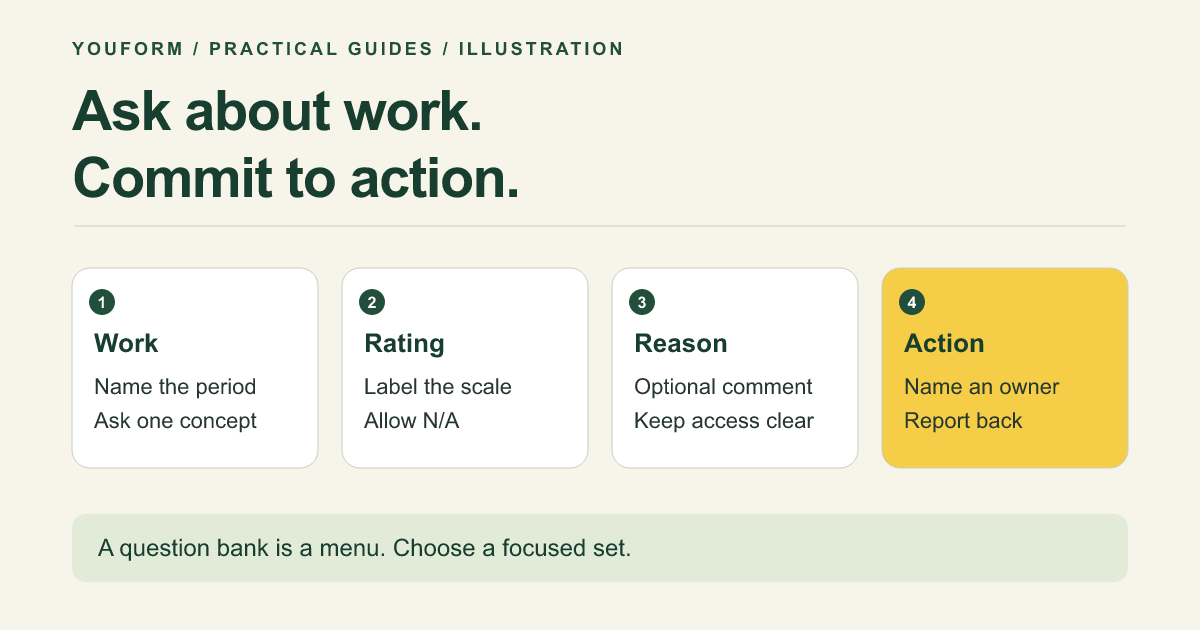
Use the smallest set that answers your current decision. Start with the six-question example, pilot it with intended respondents, and remove anything you cannot explain how you will use. A question bank is a menu, not a survey-length target.
Should every question be required?
No. Make open comments optional and provide truthful alternatives such as “Not applicable” for ratings. Employees should not have to invent an answer about training they did not receive.
Should employee surveys be anonymous?
Choose the approach before collecting answers. Anonymous feedback and named support requests serve different purposes. Explain actual access and identification risks; a form builder cannot guarantee anonymity on your behalf.
Editorial examples and linked product guidance reviewed November 10, 2026. No employee responses were collected to create this guide.