


Your support survey comes back glowing. The next week, a customer cancels because getting help took too much effort. Was the customer inconsistent? Possibly. But read the question again: “How helpful was our friendly support team?”
You asked them to evaluate a team you had already described as friendly. You also left out whether the issue was resolved. A generous rating can hide a frustrating experience.
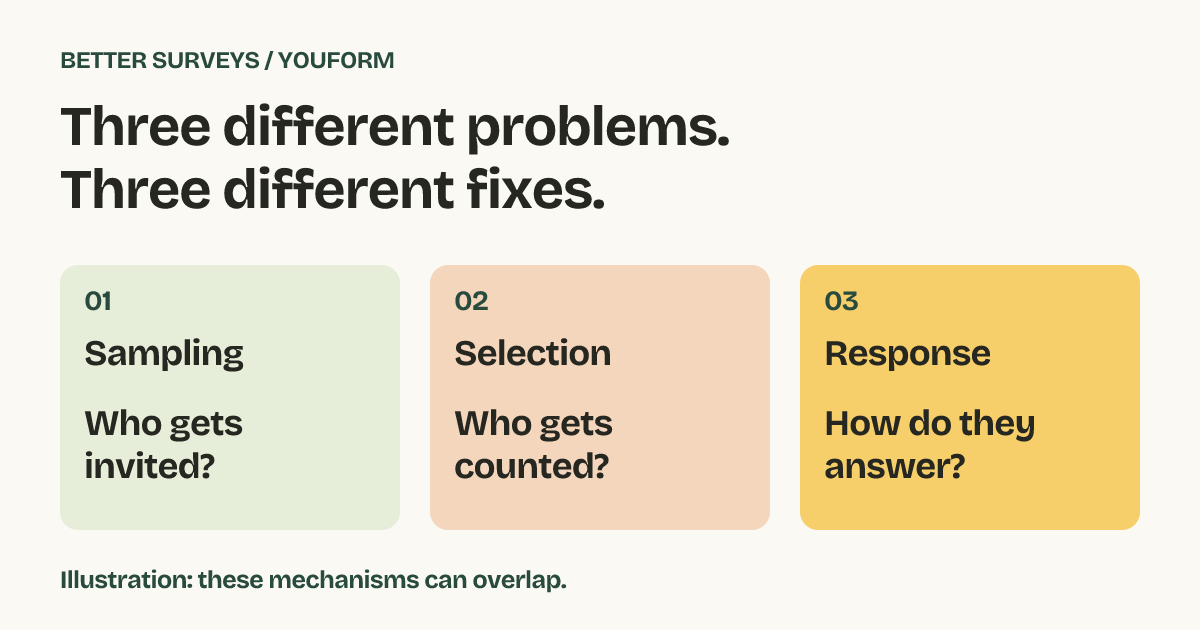
Response bias is a systematic distortion in the answers people give because of question wording, memory, social pressure, or the way a survey is presented. It concerns how people answer. Whether you reached the right people is a separate problem, covered in our guides to sampling bias and selection bias.
7 types of response bias, with examples you can fix
These are seven useful categories for reviewing a customer questionnaire, rather than a complete or mutually exclusive taxonomy. A single question can have more than one problem. The customer examples below are illustrative.
1. Acquiescence: agreeing because agreement is the easy answer
“Our onboarding process was straightforward. Agree or disagree?” makes agreement the starting point. Some respondents tend to agree with statements regardless of the underlying experience.
Try: “How easy or difficult was it to complete your first setup?” Offer a balanced range from Very difficult to Very easy. If you are tracking an established agreement-based measure, keep its wording consistent and document any change rather than silently replacing it.
2. Social desirability: giving the answer that feels acceptable
A customer might say they read your setup guide because “I never opened it” feels like admitting fault. An employee might praise a process when the manager who designed it is standing nearby.
Try: “Which of these, if any, did you use during setup?” Include “I didn’t use a guide.” State who can see answers. If responses carry a customer identifier, do not describe the survey as anonymous.
3. Leading wording: putting the conclusion inside the question
“How much time did our new dashboard save you?” assumes a benefit. Someone who took longer has no comfortable answer.
Try: “Compared with the previous dashboard, did completing [task] take less time, about the same time, or more time?” Include “I haven’t used both.” A useful question leaves room for the result you would rather not hear.
4. Recall bias: asking memory to act like a transaction log
“How many times did you contact support in the past year?” is hard to reconstruct. A memorable recent problem may dominate the answer. Individual memory errors become bias when they systematically push results in a direction or differ across groups.
Try: ask about the most recent interaction, name a short period, or use support records for the count and the survey for how the experience felt. Do not ask a customer to estimate a number you already have.
5. Question-order effects: letting one answer set up the next
Ask about a delayed delivery, damaged packaging, and an unhelpful reply, then request an overall brand rating. You have brought three frustrations to the front of the customer’s mind.
Try: ask the overall question before detailed diagnostics when you need an unprompted overall judgment. Keep that order consistent in recurring surveys. If you change the order, treat it as a possible measurement change.
6. Answer-order effects: giving an option an accidental advantage
A feature list always begins with Analytics and ends with Notifications. Some respondents may choose an early visible option without considering the full list.
Try: keep unordered lists short and test alternative orders in otherwise equivalent survey versions. Preserve the sequence of ordered scales: “Very dissatisfied” through “Very satisfied” should stay in order. Randomization is a research design choice, not a reason to shuffle every list.
7. Response styles and satisficing: getting through the survey
Someone selects the midpoint repeatedly. Another uses only the extremes. Someone else clicks the same column through a long rating grid. These patterns can reflect genuine views, but they can also reflect a response habit or low-effort answering.
Try: remove questions you will not use, label the scale clearly, and offer a separate “Not applicable” choice. Investigate suspicious patterns alongside comments and relevant context; do not delete a response merely because its score is inconvenient.
Small wording changes can produce different results
In a January 2019 survey experiment, Pew Research Center compared questions about the availability of “jobs” and “good jobs.” That is a different standard for a respondent to evaluate, even though the wording differs by one adjective. The business equivalent is asking whether your service was “fast” instead of whether its speed met the customer’s needs.
Pew’s question-writing guidance also describes agreement tendencies, social desirability, and question and answer ordering. These are measurement issues, not evidence that respondents are trying to deceive you.
For a broader reference, Choi and Pak’s peer-reviewed 2005 catalog of questionnaire biases identifies problems arising in individual questions, the questionnaire as a whole, and its administration. The examples above apply those ideas to everyday customer feedback.
A practical review before your next survey
- Name the decision. “Find the difficult onboarding step” is more useful than “collect feedback.”
- Read every question as a dissatisfied customer. Can you answer without contradicting its premise?
- Separate concepts. “Fast and helpful” needs two ratings. See our double-barreled question examples.
- Check the exits. Someone who did not use the feature needs a truthful way to say so.
- Watch a small pilot. Ask a few intended respondents to explain what each question means to them. This checks comprehension; it does not validate the whole survey statistically.
In Youform, start with a feedback survey template, edit the wording, and preview the complete path on a phone. Use conditional logic to show follow-ups only where they make sense. A clean interface helps people respond, but the wording still needs a human review.
Leave room for the comment you did not predict
In her published Youform testimonial, Jen Dangelo of NAPEX describes the team helping with questions and says they “even implement suggestions I have had.” Read her full account.
That is a specific customer experience, not a survey-wide result. It illustrates why an optional “What should we change?” can be more useful than another flattering rating. Leave a place for a person to tell you that you asked the wrong question.
What if you have already collected biased answers?
Keep the original wording with the result. Describe the problem, avoid interpreting more than the question measured, and revise the next survey. You cannot recover an unprompted opinion from a leading question after the fact.
If the old result is a tracked metric, run an overlap test with the old and revised wording where practical. Otherwise, mark the revision as a break in the series. A lower score after a wording change may be better measurement rather than a worse customer experience.
Questions people ask about response bias
Is nonresponse bias a type of response bias?
They are often discussed together, but the mechanisms differ. Response bias distorts supplied answers. Nonresponse bias arises when the people who answer differ from those who do not in ways relevant to the result.
Does an anonymous survey remove response bias?
It may reduce some social pressure, but it cannot fix a leading question, a confusing scale, or an unrealistic recall period. Anonymity also depends on the identifiers and context you collect.
Can AI check my survey for bias?
AI can suggest clearer wording and flag assumptions. Ask it to explain each proposed change, then review the draft yourself. It cannot establish that your sample is representative or guarantee unbiased answers.
Before sending: choose one question you most want a positive answer to. Read it again with an unhappy customer in mind. That is often the best place to start editing.
Research and published customer account reviewed October 27, 2026. Worked customer scenarios are illustrative; quoted feedback is attributed to its published source.