


Imagine an onboarding survey that appears when someone finishes setup. Most respondents say getting started was easy. That sounds reassuring until you notice the rule: people had to finish setup to see the survey.
The people who got stuck were never asked.
Selection bias occurs when the process that puts people into a survey or its analysis systematically favors certain experiences, making the result misleading for the population you want to describe. It can happen when choosing invitees, when people volunteer, when they drop out, or when you decide which responses count.
The challenge is not that a sample has a boundary. Every useful study has one. The challenge is forgetting that boundary when you turn responses into a claim.
5 ways selection bias can enter a customer survey
1. Coverage: the right people are missing from the list
Your question is “Why do customers leave?” but your CRM export includes only active subscribers. A perfect response rate from that list would still miss former customers.
Better approach: define the relevant cancellation period, identify eligible former customers, and decide how to reach them appropriately. Keep current-customer satisfaction and cancellation feedback as separate studies when they concern different populations.
2. Self-selection: participation depends on wanting to speak
A public feedback link attracts people who notice it and choose to respond. Fans, frustrated customers, and community regulars may have different reasons to take part. You cannot infer which group dominates just by calling the survey voluntary.
Better approach: use the open link to discover issues. If you need a customer-wide estimate, select invitations from a suitable customer list and examine subsequent nonresponse. AAPOR’s survey guidance distinguishes probability and nonprobability designs; being online does not by itself decide which kind a survey is.
3. Survivorship: only successful customers remain visible
Your usability research recruits only weekly active users. They are useful people to talk to, but their continued use may depend on having overcome the problems you hope to discover.
Better approach: include people who tried and stopped when the decision concerns adoption. Ask different, relevant questions of successful users and people who abandoned the task. Do not force someone who never finished to rate a completed experience.
4. Dropout: people disappear partway through
A long survey asks for an account number before the final effort rating. People who cannot find it may leave. If you analyze only complete responses, that friction can remove a relevant group from your score.
Better approach: put essential outcome questions early, collect only necessary information, and compare completion patterns where data are available. A missing answer is not a zero, a neutral score, or permission to invent an answer. Youform’s partial-submission feature requires Pro; it cannot recover people who never opened the form.
5. Analysis filters: the definition changes after results arrive
You remove customers who rated support poorly because their tickets were “unusual.” Then you describe the result as overall support satisfaction. That filter can make the reported experience artificially favorable.
Better approach: define legitimate exclusions before reviewing outcomes. If a response is genuinely outside the study, record why. Show the result with and without a consequential filter when that helps readers understand its effect.
Selection bias, sampling bias, and response bias
| Problem | What changes? | Customer example |
|---|---|---|
| Selection bias | Who enters or remains in the evidence | Only successful setups enter the analysis |
| Sampling bias | Who the sampling process includes | Invitations go only to a customer advisory group |
| Response bias | How people answer | “How much did you love setup?” presumes approval |
Terminology overlaps across research fields. In these guides, we use selection bias as the broader inclusion problem, sampling bias for selecting the survey sample, and response bias for systematic distortion in supplied answers. Identify the mechanism before choosing the remedy.
A real Youform example: useful evidence with a specific audience
In February 2025, Youform published its own product-market-fit survey account. The survey appeared on the dashboard for repeat users, ran for a week, and received about 105 responses. The post reported that 64% of respondents would be very disappointed if they could no longer use the product.
“We added it on our dashboard and only showed it to the repeated users.”
Davis Baer, Youform co-founder, February 14, 2025
That eligibility rule matters. The result describes respondents recruited from repeat users. It does not, on its own, describe everyone who registered, people who never activated, or people who had already left. The original account does not provide the invitation count needed to calculate a response rate.
Restricting a product-value study to people with meaningful product experience can be deliberate and useful. The mistake would be generalizing the finding to a different audience. This interpretation follows from the published recruitment method; it is not a reanalysis of Youform’s underlying responses.
Follow the people through the funnel before you trust the headline
For your next survey, write down these five numbers where available:
- Eligible: how many people met the study definition?
- Selected: how many were chosen for an invitation?
- Reached: how many invitations were delivered or displayed?
- Responded: how many supplied an answer to the main question?
- Analyzed: how many remained after exclusions?
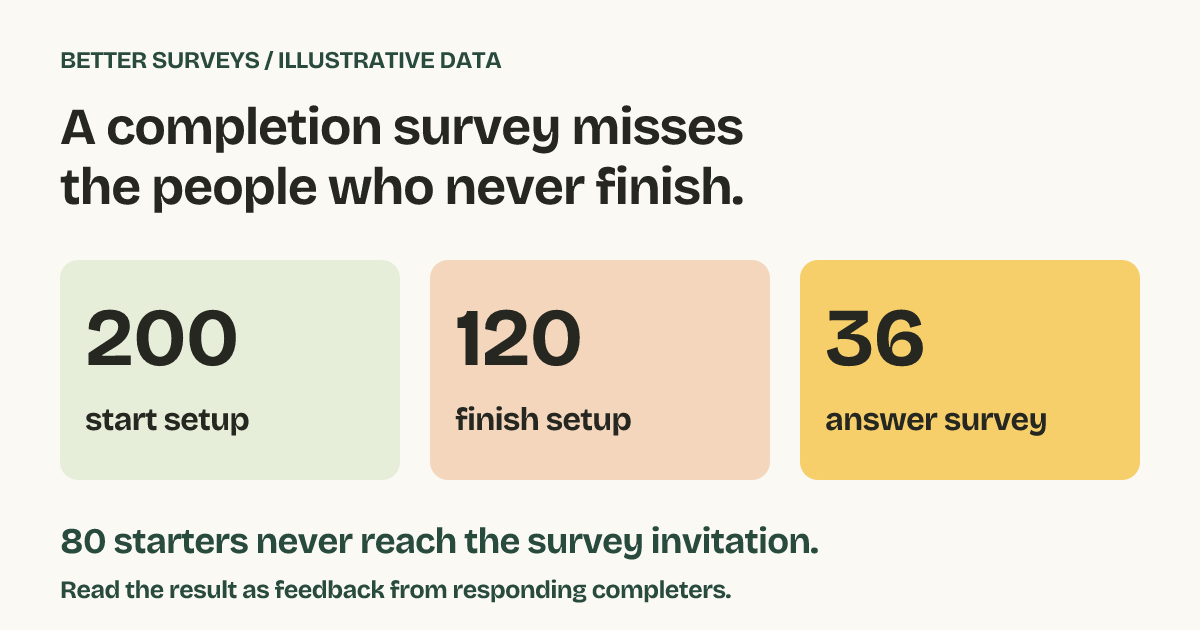
In our illustrated onboarding example, 200 people start, 120 finish, and 36 completers answer a completion survey. Eighty starters never reach the invitation. The 36 answers can describe those respondents; they cannot establish how easy setup was for all 200 starters.
Now ask what might predict each transition. Does the invitation require a successful payment? Do respondents have to log in? Does the analysis exclude a language, plan, region, or unresolved case? Look especially for a rule connected to the outcome you want to measure.
Can you fix selection bias after collecting responses?
Sometimes you can improve an analysis, but you cannot reconstruct an absent group’s experience from nothing. Known population information may support weighting under explicit assumptions. Comparing included and excluded groups can reveal a problem. Neither makes all unobserved differences disappear.
If the survey was a convenience sample, a precise-looking confidence interval does not erase selection. Statistics Canada’s questions to ask about surveys explains why conventional margins of sampling error depend on probability sampling.
A practical recovery plan is to keep the original result scoped to its respondents, document exclusions, and run a targeted follow-up with the missing group. An initial survey can still identify a real bug or a useful interview lead without estimating its prevalence.
Put the decision rule into your survey brief
Before building in Youform, complete this short brief:
We need to learn [decision] from [eligible population] during [period]. We will invite people through [selection method and channel]. We will include [inclusion rule] and exclude [rule with reason]. We will compare respondents with [known customer information] before making [intended claim].
Then create the relevant questions in the survey builder and test the paths that different customers will see. Keep contact-list selection and invitation records outside the form where appropriate. Use only the identifiers needed for your analysis and explain their purpose.
Common questions about selection bias
Is a survey of loyal customers always biased?
Not for every purpose. It may suit a study of why loyal customers stay. It cannot automatically describe why other customers leave or why prospects never buy.
Does random sampling eliminate selection bias?
It improves the invitation-selection step when implemented from a suitable frame. Missing contact information, nonresponse, dropout, and later exclusions can still change who appears in the final analysis.
Should I discard a survey if I discover selection bias?
Keep supported observations and narrow the claim. Investigate the missing experiences before turning an exploratory finding into a customer-wide percentage.
A useful final check: replace “our customers think” with “the people who answered this survey said.” If the claim suddenly feels much smaller, you have found a boundary worth explaining.
Research and the published Youform survey account reviewed October 27, 2026. The onboarding funnel is illustrative; the 2025 Youform figures retain their original audience and date.