


Market research survey questions help you decide whom to serve, which problem matters, what alternatives people use, and which offer deserves a test. Start with a business decision and a defined audience. Then ask about recent behavior before introducing your concept.
The 25 questions below are original examples to adapt, with suggested formats and interpretation notes. They are a menu, not one universal questionnaire. An early-stage service business does not need a demographic census to find out why prospects abandon a booking.
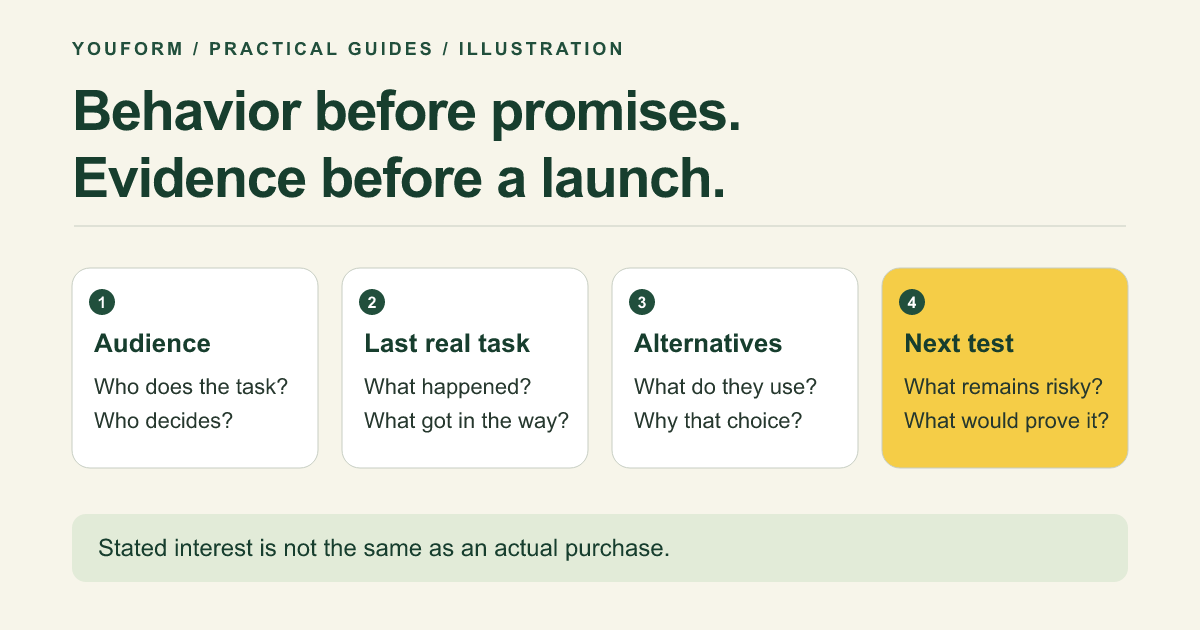
Write the decision before the questionnaire
Use this short brief: “We need to decide [action] for [audience]. We currently believe [assumption]. Answers about [behavior or unmet need] would make us change that decision.” If a question cannot affect the decision, remove it.
Illustrative brief: a small bookkeeping firm wants to decide whether to pilot monthly cash-flow check-ins for independent retailers. It needs to understand recent cash-flow decisions, current workarounds, and buying responsibility, not whether respondents generally like “better financial insights.”
Questions 1–5: reach the right audience
- Which best describes your involvement in [relevant task]?
Use a role-based choice list: do it myself, share responsibility, approve the decision, or not involved. Route people without relevant experience away from detailed task questions.
- When did you last [buy or use the category]?
Offer mutually exclusive periods appropriate to the category, plus “Never.” Recent experience is more useful than an invented purchase history.
- How often do you [perform the task]?
Use a frequency list that fits the workflow. Daily, weekly, monthly, less often, and never may fit bookkeeping but not buying a home.
- Which type of organization or situation best describes you?
Use only categories needed for the decision, with “Something else” and “Prefer not to say” when appropriate. Do not collect sensitive characteristics by habit.
- Who else is involved in deciding whether to buy [category]?
Allow multiple selections, including “Only me” and “I am not involved in purchasing.” This helps distinguish a user's need from a buyer's authority.
Questions 6–10: needs and recent behavior
- Think about the last time you [task]. What were you trying to accomplish?
Use short text. A recent example gives context before you introduce your preferred problem or solution.
- What, if anything, made that task difficult?
Use optional text. “If anything” leaves room for a person who has no problem, unlike “What frustrated you?”
- What happened because of that difficulty?
Use text or a relevant choice list, including “No significant consequence.” Distinguish an annoyance from a problem worth paying to solve.
- What did you do to complete the task?
Use text first, then categorize responses. Include manual work, a colleague, an outside service, and doing nothing in any later closed-choice version.
- Which part of that process would you most want to change?
Use a single choice from real process stages or text. Asking for the top priority is more useful than rating every possible improvement “important.”
Questions 11–15: alternatives and buying decisions
- Which products or services in [category] come to mind?
Ask unaided awareness as text before showing brand names. A list of brands would change the task into recognition.
- Which of these alternatives have you used in [defined period]?
Use multiple choice with “None of these” and “Something else.” Separate awareness from actual experience.
- What led you to choose your current approach?
Use text or a single main-reason choice. Ask about a real choice rather than whether each selling point sounds attractive.
- What nearly stopped you from choosing it?
Use optional text, with room for “Nothing.” Objections can inform an offer or an explanation without assuming price is the only barrier.
- What would need to happen for you to consider a different approach?
Use optional text. Treat the result as a switching condition to investigate, not proof that the person will switch.
Questions 16–20: concept and message testing
Show a short, factual concept description before these questions. Describe the proposed workflow, audience, and boundaries. Do not call it revolutionary or include benefits you have not established.
- In your own words, what would this service help someone do?
Use text. If people cannot explain the concept, their appeal rating may measure something you did not intend.
- How relevant is this concept to a problem you currently have?
Use Not at all relevant through Extremely relevant, plus “I do not understand the concept.” Do not combine comprehension and relevance into one score.
- Which part, if any, would be most useful to you?
Use a single choice from the actual offer components, including “None.” This helps narrow a pilot instead of expanding it indefinitely.
- What concern or unanswered question would you have before trying this?
Use optional text. Look for implementation, trust, and effort concerns as well as objections to the feature list.
- How would this fit with the way you work today?
Use text. An appealing concept may still fail if it requires a workflow the buyer cannot adopt.
Questions 21–25: price, purchase process, and next steps
- What did your organization spend on its current approach in [period]?
Use currency-labeled non-overlapping bands, plus “Nothing,” “Don't know,” and “Prefer not to say.” State whether staff time is included.
- Who would approve the budget for a service like this?
Use role choices or short text. You usually need the role, not a person's private contact information.
- At [specific price and billing period], how likely would you be to consider this offer?
Use Very unlikely through Very likely. This is stated consideration, not a sales forecast or an optimized price.
- What would you need to see before deciding whether to buy?
Offer actual options such as a sample output, a demonstration, a pilot, or a reference, plus “Something else.” Use the answer to design the next test.
- Would you like an invitation to discuss a pilot?
Use Yes or No and a separate, clearly explained contact step. Keep contact details separate from anonymous research when that is your promised design.
A six-question market research survey for the bookkeeping pilot
Use questions 1, 6, 7, 9, 18, and 24. First establish responsibility and the most recent cash-flow task. Then ask about obstacles and current workarounds. Only after those answers, show the proposed monthly check-in and ask about concerns and decision evidence.
Write the concept plainly: “A monthly 30-minute review of your cash-flow forecast using your existing bookkeeping records. You receive a written list of upcoming payment gaps and agreed next steps. This pilot does not include tax advice or daily bookkeeping.” This is an illustrative offer, not a Youform service.
If respondents mainly struggle with missing records rather than interpreting forecasts, the firm may need a different pilot. That is a useful result even if it contradicts the original idea. Use follow-up interviews to understand unclear answers before committing to a wider launch.
Four conclusions this survey cannot make for you
- “People said they would buy, so revenue is guaranteed.” Stated intention is not an actual purchase. Test a real offer through an appropriate next step.
- “Our email list represents the market.” Existing followers may differ from the buyers you want to reach. State recruitment and audience limits.
- “A large sample fixes a biased invitation.” More answers from the wrong audience do not make it representative.
- “One price question found the ideal price.” Pricing decisions need a suitable method, cost and demand context, and often additional testing.
See sampling bias and selection bias before generalizing. Keep a record of the exact question wording, recruitment method, valid answer counts, and changes between rounds.
Build a focused research survey in Youform
Start with the market research survey template. Edit the audience screen, use logic to show relevant questions, and keep concept exposure after unprompted behavior questions. Preview the full path before distributing it.
Youform is a collection tool, not a respondent panel or a guarantee of representative research. Its free plan includes unlimited forms and responses, so you can iterate the questionnaire without a response-volume upgrade. You still own recruitment, research design, and analysis. Check current plan boundaries for other requirements.
Market research survey FAQs
Should demographic questions come first?
Begin with eligibility questions that are necessary to route the survey. Put other profile questions later unless they are essential at the start, and remove characteristics you will not use.
How many responses do we need?
That depends on the population, sampling method, decision, and precision you need. A few exploratory answers can improve a concept but cannot establish market prevalence. Do not attach a conventional margin of sampling error to an unrestricted convenience sample.
Can AI write the questionnaire?
AI can draft alternatives. A person still needs to check assumptions, answer choices, recruitment, and how each answer changes the decision. Pilot the wording with people from the intended audience.
Sources and editorial method
Reviewed November 10, 2026. The questions and bookkeeping example are original editorial suggestions. Qualtrics' research-question overview provides category context; Pew's question-writing guidance supports the wording and ordering principles. Product scope follows Youform's logic documentation and current pricing.