


A useful customer satisfaction survey asks how satisfied someone is with a specific experience, why they gave that answer, and what would improve it. Add diagnostic questions only for the part of the journey the customer actually used: buying, onboarding, product use, delivery, or support.
These 25 original question examples include suggested formats and the decision each answer can support. Pick a small relevant set. Do not make a customer complete the whole bank after a two-minute support interaction.
Two short customer satisfaction surveys
After a support interaction
Ask question 1 about the support experience, question 12 about resolution, and question 25 about an improvement. Show a relevant follow-up if the issue is unresolved. A friendly agent and an unresolved problem can coexist, so do not use one rating as a substitute for the other.
After a purchase or first use
Ask question 1 about the named purchase or first-use experience, question 7 about the buying step, and question 24 about the main reason. Ask delivery questions only after the item arrives. A checkout survey cannot measure the quality of a product someone has not received.
For the satisfaction questions below, use Very dissatisfied, Dissatisfied, Neither satisfied nor dissatisfied, Satisfied, Very satisfied. Keep “Not applicable” separate when needed. Label the whole scale rather than showing five unexplained numbers.
Questions 1–5: overall satisfaction and expectations
- Overall, how satisfied are you with [specific experience]?
Use the satisfaction scale. Name the purchase, support interaction, or product period so the answer has a clear reference point.
- How well did [product or service] meet the expectations set before you bought it?
Use Not at all well through Extremely well, plus “I did not have a clear expectation.” Investigate a gap between the promise and delivery.
- How satisfied are you with the value you received for the price paid?
Use the satisfaction scale. Route this to people who know the price; a free user or employee of the purchasing organization may not.
- Which part of the experience worked best for you?
Use optional text. Identify strengths to preserve rather than redesigning everything in response to a low overall score.
- Compared with what you needed, how well did [product or service] perform?
Use Not at all well through Extremely well. Ask what need was unmet when the answer can inform product or service changes.
Questions 6–10: buying, delivery, and onboarding
- How clear was the information you needed before purchasing?
Use Not at all clear through Completely clear. Ask what was missing if unclear specifications or terms may be the problem.
- How easy or difficult was it to complete your purchase?
Use Very difficult through Very easy. Diagnose the buying process separately from product satisfaction.
- How satisfied are you with the delivery of your order?
Use the satisfaction scale and ask only after delivery. Follow up on the relevant issue: timing, condition, or missing items.
- How clear were the instructions for getting started?
Use Not at all clear through Completely clear, plus “I did not use the instructions.” Distinguish content quality from discoverability.
- What, if anything, prevented you from getting started?
Use text or a list of actual setup obstacles, with “Nothing prevented me” and “Something else.” Route a practical support response when appropriate.
Questions 11–15: support and resolution
- How easy or difficult was it to reach the support you needed?
Use Very difficult through Very easy. Ask about channel access, not whether the agent was friendly.
- What is the current status of the issue you contacted us about?
Offer Fully resolved, Partly resolved, Not resolved, and No resolution needed. This makes unresolved cases visible even when the interaction rating is positive.
- How clear was the explanation or guidance you received?
Use Not at all clear through Completely clear. Review confusing instructions before assuming the customer needs more training.
- How satisfied are you with the time it took to receive a useful response?
Use the satisfaction scale. Check the support record for elapsed time instead of asking customers to reconstruct it.
- What should we have done differently during this support interaction?
Use optional text. Keep the focus on an actionable interaction rather than a public rating of an individual employee.
Questions 16–20: product use and reliability
- How easy or difficult is it to complete [main task] using [product]?
Use Very difficult through Very easy. Specify the task rather than asking if the whole product is “user-friendly.”
- How satisfied are you with the reliability of [product] during [recent period]?
Use the satisfaction scale. Ask what failed, then investigate alongside technical records; a survey does not establish system uptime.
- Which part of [task] takes more effort than you expected?
Use optional text and allow “None.” A task-level example is more useful than another overall usability rating.
- Which feature or service do you rely on most?
Use a choice list of current features or text. Review this with actual usage when available, not as a complete measure of demand.
- What is one change that would help you get more value from [product]?
Use optional long text. Ask for the underlying task if the answer names a feature without explaining the problem.
Questions 21–25: future intent and follow-up
- How likely are you to use [product or service] again?
Use Very unlikely through Very likely, plus “I do not expect to need it again.” Repurchase intention is not the same as a completed purchase.
- How likely are you to recommend [company] to a friend or colleague?
Use the standard 0 to 10 format if calculating NPS. Keep recommendation separate from your CSAT percentage; the measures use different questions and calculations.
- May we contact you about this feedback?
Use Yes or No, then request a contact method only where needed. Explain the purpose and do not treat support permission as marketing consent.
- What is the main reason for your satisfaction rating?
Use optional text immediately after the primary rating. This is often the most useful follow-up when you can ask only one.
- What is the one thing we should improve about this experience?
Use optional text. Avoid listing your planned improvements first if you want to hear an unprompted priority.
How to calculate CSAT without mixing metrics
For the five-point satisfaction scale above, define a satisfied answer as Satisfied or Very satisfied. Then calculate:
CSAT = satisfied valid answers ÷ all valid answers to that satisfaction question × 100. Exclude skipped and not-applicable answers from this denominator, and report their counts separately.
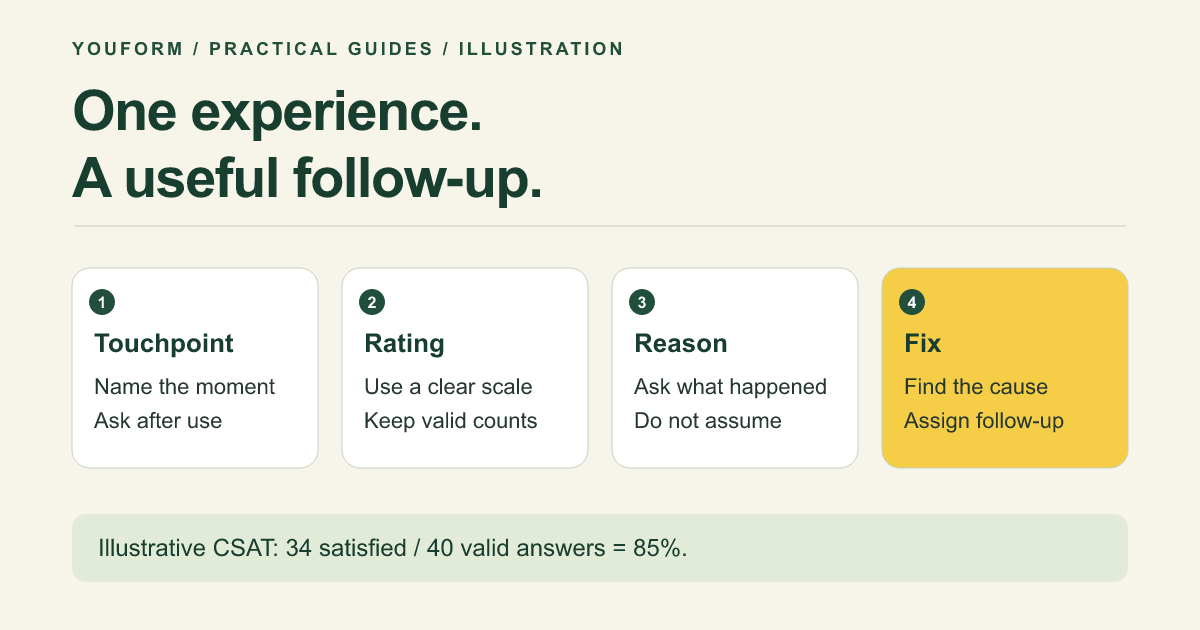
Illustrative example: 34 of 40 valid ratings are Satisfied or Very satisfied. CSAT is 85%. If 60 customers were invited, that is not “85% of customers are satisfied”; it is 85% among the 40 people who answered that question. Review who did not respond before generalizing.
SurveyMonkey's CSAT guide describes this satisfied-response percentage. A mean star rating, an NPS score, and a customer effort score are different outputs. Our CES guide helps you choose an effort question when friction is the actual decision.
Match the follow-up to the failure
A low score should create a review, not an automatic conclusion. If delivery complaints repeat, inspect fulfillment. If support was courteous but the issue remains unresolved, reopen the case through your normal process. If a product task is confusing, review that path before offering a discount.
Keep a simple action record: issue, evidence, owner, next step, and review date. When following up with a customer, refer to the specific experience they described. Restrict access to identifiable comments and do not paste private feedback into a public AI service without an appropriate basis and controls.
Create the survey in Youform
Choose a customer satisfaction survey template, replace the generic labels with your touchpoint, and use conditional logic to hide irrelevant questions. Preview a satisfied, dissatisfied, and not-applicable route before sharing.
Youform includes unlimited forms and responses on Free, with logic and a Google Sheets connection for new responses. You still need to define the CSAT calculation and access to the sheet. See pricing for paid branding, collaboration, and analytics features.
Customer satisfaction survey FAQs
What are the best three customer satisfaction questions?
Start with overall satisfaction with a named experience, the main reason for that rating, and one improvement. Replace a question with resolution status or a task-specific diagnostic when that better supports your decision.
When should we send the survey?
Send it when the customer can evaluate the experience: after delivery for delivery feedback, after meaningful use for product feedback, or after a support interaction for service feedback. Decide how unresolved cases are handled before triggering the survey.
Should we include demographics?
Only collect a characteristic if you need it for a defined analysis and can handle it appropriately. Age, income, and other personal details are not standard requirements for a useful satisfaction survey.
Original question examples and product references reviewed November 10, 2026. Numerical examples are illustrative, not Youform customer results.